
BLOG
Reclaim your voice – both inside and outside.
#11 | 3 tools to bring more color into your songs (So they sound even more like YOU)
"I feel like my voice always sounds the same."
"It sounds so boring."
"How can I make songs more interesting?"
Have one of these sentences crossed your mind too?
Introduction
I hear this so often: "I want to make this song more interesting, I want to make it my own, I want it to sound like 'my voice' – but I just don't know how!"
And I get it. It's difficult to point the finger at what exactly a singer is doing to make a song sound so interesting and individual. They might not even know how they're doing it themselves.
In this blog post, I want to share 3 tools that you probably already use sometimes, without consciously knowing about them. And once you become aware of them, it gets so much easier to apply them on purpose, to any song you like.
Table of Contents
Sing It Like You'd Say It and find YOUR expression
Add Softness with Air
Add Notes, Add Magic
Mixing the colors
Try this
(🎥 Do you want some auditive support while reading this? I also made a video about this topic that you can find on my YouTube Channel.)
1. Sing It Like You'd Say It and find YOUR expression
A great place to start is always to speak the lyrics first. It helps you find your natural rhythm, the length of your words, and where you naturally put emphasis — things you already know how to do when you talk, but that often get lost the moment we start singing.
Try speaking the words of your song out loud, as if you were really telling this story to someone.
Notice what changes. You maybe don't hold the words for very long. You naturally give some words more weight than others, and you speak with your own rhythm, not a rhythm someone else gave you.
Now try bringing that same speaking version into the melody. That maybe means shortening some of the notes a little, more like you would actually say them, rather than holding them out. Or you put more weight and emphasis on a note that didn't seem that important before.
Speech-like singing doesn't mean speaking instead of singing; it just means letting more of your natural speech patterns live inside your singing.
You'll maybe notice that it already sounds more like you, like you're telling the story rather than performing a set of notes.
2. Add Softness with Air
Another tool that brings a new color into a song is adding breathiness to some notes.
Here are three ways to find that quality for yourself:
Do a big sigh. Let it out with a bit of sound on it, almost like an "ahh" of relief. Notice how much air moves through your voice compared to normal speaking. That feeling, sound and amount of air is what we want to use for a breathy note.
Imagine you're Marilyn Monroe and sing like it. It's less about the impression and more about giving yourself permission to let go of a "clean," fully supported tone for a moment.
Imagine you're breathing onto a mirror to fog it up. That slow, warm "haaa" you'd use is a great way to get to this breathy sound. Try singing some vowels (i-a-u) while you're breathing onto the mirror.
Try each of them and notice which one feels most natural in your own voice. They're really three doors into the same room, pick whichever gets you there most easily.
Be careful and use the breathy sound as an effect – not all the way through the melody!
Since singing with a breathy voice can be quite tiring because you lose a lot of air this way, we want to use it as an effect, not as a constant setting. That means adding it only to one note, part of a note, or a short phrase. So please be a little careful with your voice here.
A good place to add softness are words that already begin with an "aspirate onset", a H and naturally start with a small breath. You can do the same with words that begin with a vowel, simply by using an aspirate onset, starting the tone a bit of breath.
Remember: less is more. Used as an effect on short moments, breathiness stays special. If you use it everywhere, it becomes tiring – for the listener and especially for you.
3. Add Notes, Add Magic
This one might feel the most challenging at first, so give yourself time to explore and experiment. But then it can be a lot of fun and add a lot of color and emotion to the song.
What do I mean by "added notes"? It simply means adding one or more extra notes in between the notes that are already in the melody.
Think of it as decorating a plain room – a candle here, a picture or a plant there. Musically, that means: between two notes of the melody, add 1, 2, or 3 extra notes as you move from one to the other. They can be different notes, or the same note repeated. Or you can start or end a note a little higher or lower than it's written. The room is still the same room, but those little details give it personality.
There's no right or wrong here. Choose whatever sounds good to your own ears, and remember these are decorations, not a rule to change every phrase. Less is more, start with just one or two added notes that feel natural to you and that you genuinely like.
4. Mixing the colors
And of course, you can combine all three. Maybe you sing one phrase a little more speech-like, add a touch of softness with air on a single word, and decorate another phrase with one or two added notes. That's usually where a song starts to sound and feel more individual, more like you, because you brought more life to it and your expression.
5. Try this
The next time you learn a new song, ask yourself: do I want a little more speech here? A little more softness with air? Maybe an added note? Sometimes changing just one small thing is enough to shift the whole feeling of a performance.
Try these three tools on another song you already know well, and notice which one you keep reaching for. That's usually the one worth exploring further.
🎥 Watch the video to this topic on my YouTube Channel
I'd love to know which one is your favorite. If you want to hear all three in action, watch the full video on my YouTube channel "Your Confident Voice", where we practice everything together with Amazing Grace, and feel free to subscribe if it helps you.
☕️ Let's have a coffee!
If this makes you curious, or if you’ve been feeling stuck in your breath or voice lately, I invite you to a free Coffee Call:
With this link, you can book a free 20-minute Discovery Call with me.
No pressure – just a talk over a coffee and some guidance. During this discovery call, we can discuss your goals and needs, and how I can support you best. I am excited to get to know you!
A great place to start to start:
I made a mini-course called "Happy High Notes" – it's less than an hour and has 3 helpful tips for singing high notes with more ease and freedom plus an explanation why they work in the body. The price is 14.99€, and if you want, have a look here.
P.S.: To learn more about me, you can also sign up for my newsletter or connect with me on Instagram.

FREE DOWNLOAD
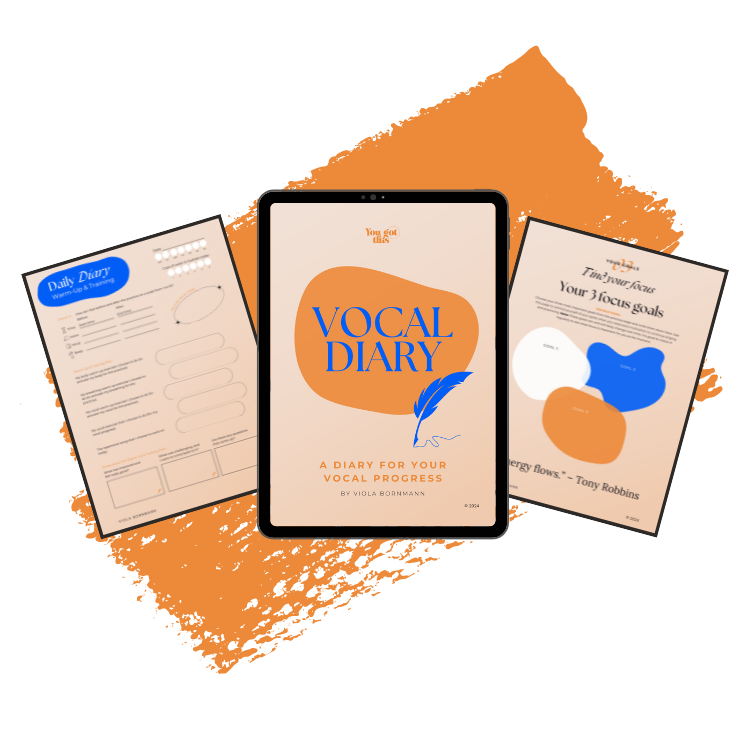
YOUR VOCAL DIARY
Are you struggling to maintain a consistent daily vocal practice routine?
The VOCAL DIARY is a guided Diary that I created to help establish a practice routine (that fits into your schedule). Get your Diary for one week for free.
Establish and nurture your practice and celebrate your progress. You got this!